On this page
At a glance
This departmental plan details the Immigration and Refugee Board of Canada's (IRB or the Board) priorities, plans and associated costs for the upcoming three fiscal years.
These plans align with the priorities outlined in the
Mandate Letter, as well as the Board's
Vision, mission,
raison d'être and operating context.
Key priorities
The Board identified the following key priorities for 2026 to 2027:
- Maintain quality decision-making – The IRB will continue to ensure integrity by applying the law as it hears and decides cases across all four divisions.
- Improve efficiency – The Board will prioritize key initiatives designed to strengthen operational capacity, such as those that leverage technology for efficiency gains.
- Manage operational challenges – Supported by its robust performance measurement framework, the IRB will strategically allocate resources and monitor performance in order to effectively respond to emerging operational and environmental challenges.
Comprehensive Expenditure Review
The government is committed to restraining the growth of day-to-day operational spending to make investments that will grow the economy and benefit Canadians.
The IRB does not have planned reductions under the Comprehensive Expenditure Review.
The Board will, however, respect the spirit of the exercise by doing the following:
- Reviewing internal services cost models to seek out savings; and
- Continuing to identify opportunities to reduce the administrative costs of managing cases (e.g., cost of registry and other adjudicative support functions).
These measures are made possible, in part, by efficiency gains from ongoing initiatives such as automation and process simplification, which continue to enable the IRB to strategically reallocate resources.
This departmental plan reflects these measures.
Highlights for the Board in 2026 to 2027
The IRB will adhere to its mandate, deciding refugee and immigration matters in an impartial and fair manner, maintaining the quality of its decision‑making while ensuring that all hearings are conducted in a way that upholds natural justice and procedural fairness. At the same time, the Board will continue the implementation of its strategic plan, Horizon 2026-27, building on efficiency efforts to further strengthen operational capacity.
In particular, the Board will continue the development of a new scheduling tool. This tool, supported by an updated scheduling process, will reduce the administrative burden of scheduling and the impacts of postponed hearings through automation and increased functionality.
In addition, the IRB will advance decision-making tools to accelerate file preparation and support decision‑drafting. Furthering the work that is already under way, these tools will help decision‑makers generate their reasons in a format that is concise, focused and accessible. These tools do not replace decision‑makers or limit decisions, rather, they aim to streamline decision‑writing.
The IRB will continue revising its Rules of Practice for all four divisions, ensuring a simple, consistent and fair approach to the administration of justice, while seeking to better support virtual and electronic processes, and efficient case management.
Acknowledging that there are several external variables, including Bill C-12 and intake levels, that could impact the Board, the IRB anticipates that these initiatives, with others, will position it to realize long‑term productivity gains, leading to increased finalization of cases and improved access to justice.
In 2026 to 2027, total planned spending (including internal services) for the IRB is $344,133,766 and total planned full-time equivalent staff (including internal services) is 2,475.
Summary of planned results
The following provides a summary of the results the IRB plans to achieve in 2026 to 2027 under its main areas of activity, called “core responsibility.”
Core responsibility: Adjudication of immigration and refugee cases
The IRB, as the administrative tribunal mandated to decide refugee and immigration matters in an impartial and fair manner, must preserve the quality of its decision‑making while ensuring that all hearings are conducted in a manner that upholds the law. In fiscal year 2026 to 2027, the Board has two main objectives. First, the IRB will continue maintaining strong quality assurance practices, as identified in its
Quality Assurance Framework. Second, the IRB will continue to bolster its productivity, seeking to strengthen operational capacity. The Board has already seen concrete results from its efforts to improve efficiency, finalizing 29% more decisions in 2024 to 2025 than in the previous year.
The Board continues to cultivate a culture of excellence. With these two objectives as its central focus, the IRB will continue to generate meaningful improvements for members, registry personnel, and those appearing before the Board. This work is multi‑faceted and includes movement to national case management, continued investments in technology‑aided efficiency measures and process simplification. The Board is establishing foundational elements that will enable future innovation and technological advancements. The efficiencies generated permit the IRB to reallocate resources to further support the Board's mandate and operational pressures. Finally, the IRB is continuing to mature its operational oversight and control, actively managing performance to identify emerging operational performance risks and opportunities in a timely way.
Supporting these efforts, Budget 2025 announced Asylum Backlog Reduction funding that would provide two additional years of one‑time funding to increase first‑level asylum decisions, ending in fiscal year 2027 to 2028. This will allow for additional temporary resources in the Refugee Protection Division to increase finalizations of cases.
The IRB is also preparing for the potential passage of Bill C‑12, which could have significant implications on the Board's processes and tools. The IRB will maintain its focus, managing potential disruptions and external variables to the extent possible.
Planned spending: $261,854,862
Planned human resources: 1,983
More information about
Adjudication of immigration and refugee cases can be found in the full plan.
For complete information on the IRB's total planned spending and human resources, read the
Planned spending and human resources section of the full plan.
From the Chairperson

Manon Brassard
Chairperson and Chief Executive Officer
I am pleased to present the 2026 to 2027 Departmental Plan for the Immigration and Refugee Board of Canada (IRB or the Board), Canada's largest administrative tribunal.
Since its establishment in 1989, the IRB has been entrusted with the critical responsibility of making well‑reasoned decisions on immigration and refugee matters, efficiently, fairly and in accordance with the law. As an administrative tribunal, the Board applies its expertise to hear and decide a high volume of cases while maintaining quality and upholding legal standards. I am proud that we continue to meet and exceed our targets for quality and finalizations.
According to the United Nations High Commissioner for Refugees, new asylum claims decreased globally in the first half of 2025, but the number of pending cases remains highFootnote 1— a pattern also evident in Canada. Although asylum claims in the Refugee Protection Division have dropped from their 2023 to 2024 peak, they remain above funded capacity, leading to significant caseload inventory. Intake of appeals in the Refugee Appeal Division and Immigration Appeal Division is rising, while admissibility and detention case intake in the Immigration Division is down, despite increasing case complexity.
Faced with a large caseload across all four divisions, the IRB has strengthened its operations, increased productivity, and improved efficiency, enabling it to reallocate resources to address operational pressures. Fiscal year 2026 to 2027 marks the third year of the IRB's Horizon 2026-27 plan, focusing on process standardization, automation where possible, and managing cases as a single national inventory through strategic case management. With improved operational awareness and ongoing performance management, the Board will strategically direct resources to the highest-value activities. Temporary funding from Budget 2025 will further support this work.
Fiscal Year 2026 to 2027 will likely present a number of disruptions to its current operations which may pose a challenge to the realization of its stated objectives. The adoption of Bill C‑12 would require significant changes to some of the Board's processes, and while this prospective legislative change should result in an overall reduced burden on IRB case management and streamlined processing by limiting referrals to schedule-ready claims, there is expected to be a significant amount of work required to align with new legislative requirements.
Other external variables can also affect the IRB. This includes shifts in international immigration, which can make intake unpredictable. The growing use of artificial intelligence by claimants and their representatives also has the potential to cause disruption. The IRB will work diligently to anticipate and address any potential disruptions, remaining focused on the work at hand.
IRB employees consistently show dedication and professionalism, achieving solid results despite ongoing challenges. I am confident the IRB will remain adaptable and will continue to fulfil its essential role within Canada's immigration and refugee system.
Plans to deliver on the core responsibility and internal services
Core responsibility and internal services
Core responsibility: Adjudication of immigration and refugee cases
In this section
Description
The Immigration and Refugee Board renders quality decisions and resolves cases in a timely manner regarding immigration and refugee protection cases. This includes determining refugee protection claims and appeals and applications to vacate or cease refugee protection. It also includes making decisions in admissibility hearings and detention reviews, and on appeals on certain immigration cases (e.g. family sponsorship applications, certain removal orders, applications based on meeting residency obligations and admissibility hearings).
Quality of life impacts
This core responsibility contributes to the “Good Governance” domain of the
Quality of Life Framework for Canada. The domain indicator reflected in the core responsibility description is:
- Confidence in institutions
Indicators, results and targets
This section presents details on the IRB's indicators, the actual results from the three most recently reported fiscal years, the targets and target dates for the Adjudication of immigration and refugee cases. Details are presented by departmental result.
Table 1: Fair and timely adjudication of immigration and refugee cases
Table 1 provides a summary of the target and actual results for each indicator associated with the results under Adjudication of immigration and refugee cases.
| Departmental result indicators | Actual results | 2026 to 2027 target | Date to achieve target |
|---|
The percentage of IRB cases that meet or exceed the quality standard | 2022 to 2023: Not availableFootnote 1 2023 to 2024: 95% 2024 to 2025: Not availableFootnote 1 | At least 80% | March 2028 |
Percentage of IRB decisions overturned by the Federal Court | 2022 to 2023: 0.5% 2023 to 2024: 0.5% 2024 to 2025: 0.7% | At most 1% | March 2027 |
Percentage of program-level annual timeliness targets met | 2022 to 2023: Not availableFootnote 2 2023 to 2024: Not availableFootnote 2 2024 to 2025: Not availableFootnote 2 | At least 80% | March 2027 |
Additional information on
detailed results and performance information for the Board's program inventory is available on GC InfoBase.
Plans to achieve results
The following section describes the planned results for the Adjudication of immigration and refugee cases in 2026 to 2027.
Fair and timely adjudication of immigration and refugee cases
Mandated to decide refugee and immigration matters in an impartial and fair manner, the IRB is one part of a complex and evolving immigration and refugee system. While the Board must use its expertise to hear and decide a high volume of cases, particularly in its Refugee Protection Division, it must also maintain the quality of its decision‑making while ensuring that all hearings are conducted in a manner that upholds natural justice and procedural fairness. The IRB has maintained strong quality assurance practices over many years, as identified in its
Quality Assurance Framework. It continues to uphold the law and its obligations as an independent, accountable administrative tribunal.
To this end, decisions on refugee claims made by the IRB must conform with the
Immigration and Refugee Protection Act (IRPA), the
Canadian Charter of Rights and Freedoms, the United Nations
Convention Relating to the Status of Refugees and Supreme Court of Canada jurisprudence. The IRPA provides that it is to be interpreted and applied in a manner that complies with the international human rights instruments to which Canada is a signatory.
The Supreme Court of Canada held that both the
Canadian Charter of Rights and Freedoms and the
Canadian Bill of Rights apply to the determination of refugee claims by the IRB. The Supreme Court also held that where a serious issue of credibility is involved, fundamental justice requires that credibility be determined in an oral hearing. The courts have also consistently held that given the nature of the rights being adjudicated, both the Refugee Protection Division and the Refugee Appeal Division must afford the parties before them a high degree of procedural fairness. The Supreme Court emphasized that an administrative tribunal must provide cogent reasons for decision, and that in conducting a judicial review of the reasonableness of a decision of an administrative tribunal, a court must ensure that the decision as a whole is transparent, intelligible and justified.
The IRB remains focused on meeting demand for all its divisions. Intake of refugee protection claims is anticipated to be around 100,000 cases in fiscal year 2025 to 2026. While this is a reduction from the previous two fiscal years, it will nonetheless leave an accumulated inventory of around 300,000 cases at the end of March 2026. Temporary funding announced in Budget 2025 is expected to provide two additional years of one-time funding to increase first-level refugee protection decisions. In this context, the Board aims to meet the current demand for refugee protection claims while also addressing accumulated inventory. Additionally, the IRB will strive to continue to meet the demand for its other three divisions, where intake continues to increase in volume and complexity.
The Board has seen tangible results from its efforts to scale capacity, finalizing over 102,500 decisions in 2024 to 2025, 17,800 decisions over its funded capacity, and a 29% productivity increase from the year before. To cultivate a culture of excellence and continue to achieve and surpass its targets, the Board will focus on a small number of important initiatives which, combined, aim to significantly improve operational efficiency. The IRB will continue investing in process simplification and the use of technology. At the same time, the Board is strengthening foundational elements to enable future innovation and technological progress and is improving operational awareness and performance management. It is also preparing for the potential passing of Bill C‑12, which could have significant implications for its processes and tools, and it is monitoring for other potential external disruptions.
Results we plan to achieve
At the center of its plans, the IRB aims to maintain quality decision‑making and improve efficiency. The Board is approaching these core objectives from multiple perspectives, focusing on important initiatives that will support key parties within the adjudication process. In 2026 to 2027, the IRB will advance work on simplifying processes and automating low-value activities, leveraging technology to better support case management and adjudicative functions. While the initiatives planned for 2026 to 2027 could have a broad impact across several parties, the primary beneficiary for each initiative is outlined below.
Members
- Taking a systematic approach to simplifying and standardizing operations, the Board will complete divisional process reviews and implement changes as appropriate.
- Building on previous success, the IRB will further develop tools to accelerate file preparation and support decision‑drafting across the IRB's four divisions. These tools help decision-makers work through the framework of analysis to generate their reasons, oral or written, in a format that is concise, focused and accessible. These tools do not replace decision-makers or limit decisions, rather, they aim to streamline decision-writing.
Registry and adjudicative support
- Automating the creation of a common, structured and searchable electronic file (e‑file) for each division, drawing directly from case data, the IRB will eliminate some of the most time-consuming manual tasks undertaken by registry staff. Members will also benefit from this e‑file.
- Replacing fragmented scheduling systems currently used across the IRB's four divisions with a new scheduling tool, the Board will reduce the administrative burden of scheduling and the impacts of postponed hearings by automating the process and increasing functionality. This will also lay the foundation for future enhancements, through the creation of a single platform for scheduling proceedings and file assignments.
- Building on a proof‑of‑concept experiment, the IRB will pursue technology assisted triage, first in the Refugee Protection Division and then in other applicable divisions. This will enable the divisions to increase triage capacity, such as improving the streaming of files to the right member based on case attributes. Reduction of this manual work will decrease delays in the process and reduce postponements of scheduled hearings.
- Advancing foundational work to prepare the IRB's case management system for further future improvements will ensure that the Board is able to implement additional efficiency related initiatives.
- Furthering the development of updated Rules and procedures for all divisions, the Board will seek to better support virtual and electronic processes, as well as efficient case management.
Claimants and representatives
- Enhancing My Case portal functionalities will allow the IRB to continue simplifying and supporting communication with parties, allowing digital communication between the IRB, claimants and their representatives.
- Reviewing the IRB's representative and conduct‑related policy suite will ensure coherence between policy instruments and clear, consistent guidance for internal and external stakeholders.
Board leadership
- Strengthening its comprehensive management toolkit, the IRB will equip management with self-service, dynamic reporting capabilities that allows it to quickly and easily understand when projected results are likely to exceed or fall short of operational targets.
- Supported by a robust performance measurement framework, the IRB will employ active management strategies in order to optimize operations and case finalizations, as well as to effectively respond to operational and environmental challenges.
- Effective performance management and efficient resource allocation will enable the IRB to manage emerging operational performance risks or opportunities in a timely way.
- Insight into the effort, costs and time associated with different functions will allow the Board to allocate resources more effectively.
-
Regular senior management discussions to monitor the evolving geopolitical and external context will support the Board in responding rapidly to external variables that may impact the IRB's ability to achieve its objectives.
Gender-based Analysis Plus
As an independent tribunal, the IRB makes decisions on a case‑by‑case basis, with each of its four divisions adjudicating cases based on individual circumstances in accordance with the law. As part of this work, the Board applies a GBA Plus lens as per the
Chairperson's Guideline 4: Gender Considerations in Proceedings Before the Immigration and Refugee Board,
Chairperson's Guideline 8: Accessibility to IRB Proceedings — Procedural Accommodations and Substantive Considerations, and
Guideline 9: Proceedings Before the IRB Involving Sexual Orientation, Gender Identity and Expression, and Sex Characteristics. In addition, the Gender‑Related Task Force, a specialized team trained to hear and decide gender‑related refugee claims within the Refugee Protection Division, promotes respectful, trauma‑informed and consistent decision‑making, while developing and sharing best practices across the Division.
The IRB's case management system records a limited amount of information, including gender, age and country of origin of the persons appearing before the Board, as well as data on the application of Guidelines 4 and 9. This data will continue to enable the Board to analyze its client base in a gender‑disaggregated and age‑stratified way, allowing for monitoring and reporting of the impact decisions have on claimants and appellants through the lens of gender and diversity.
Planned resources to achieve results
Table 2: Planned resources to achieve results for Adjudication of immigration and refugee cases
Table 2 provides a summary of the planned spending and full-time equivalents required to achieve results.
| Resource | Planned |
|---|
Spending | $261,854,862 |
Full-time equivalents | 1,983 |
Complete financial and
human resources information for the IRB's program inventory is available on GC InfoBase.
Program inventory
Adjudication of immigration and refugee cases is supported by the following programs:
- Refugee protection decisions
- Refugee appeal decisions
- Admissibility and detention decisions
- Immigration appeal decisions
Additional information related to the program inventory for Adjudication of immigration and refugee cases is available on the
Results page on GC InfoBase.
Summary of changes to reporting framework since last year
- A single departmental‑level timeliness indicator has been introduced, while four existing indicators have been repositioned to the program level.
- New timeliness indicators have been added at the program level that better distinguish wait times that are within versus outside of the IRB's control.
- Selected indicators have revised wording and more detailed methodologies in an effort to improve clarity and to foster consistent and accurate interpretation.
Internal services
In this section
Description
Internal services are the services that are provided within a department so that it can meet its corporate obligations and deliver its programs. There are 10 categories of internal services:
- acquisition management services
- communications services
- financial management services
- human resources management services
- information management services
- information technology services
- legal services
- material management services
- management and oversight services
- real property management services (not applicable to the IRB)
Plans to achieve results
This section presents details regarding the Board's plans to achieve results and meet targets for internal services.
The IRB's internal services priorities for 2026 to 2027 are essential to the Board's ability to fulfill its mandate. As the IRB continues to navigate an evolving operating environment, the Board remains dedicated to providing all staff with the tools and training necessary to succeed in a respectful, inclusive and diverse workplace. In the current context, the IRB is committed to maintaining open, transparent communication with employees to the greatest extent possible, aiming to manage change in a thoughtful and intentional way. In 2026 to 2027, people management will remain a key priority at the Board, with a focus on investing in the current workforce while achieving a balance between core operational functions and corporate support.
To lead its work in this area, the IRB will continue to rely on several plans, including the Diversity and Inclusion Strategic Plan, the IRB Accessibility Plan, and the Psychological Safety and Mental Health Strategy. Guided by the commitments in these documents, the IRB will continue fostering a positive and healthy workplace culture, where everyone feels respected. It will also focus on further improving employee engagement, strengthening collaboration and building a sense of belonging. The IRB aims to become more inclusive and to reduce systemic bias by understanding the diverse needs of all employees and those appearing before it, regardless of sex, gender or identity. In addition, the Board will continue enhancing psychological health and safety in the IRB workplace, including through the development of tools to support managers and staff members in preventing psychological risks in the workplace. For example, the IRB is engaging employees in a peer support group network and continuing to provide Mental Health First Aid training to promote positive work‑life balance and improve the wellbeing and productivity of its workforce.
In 2026 to 2027, the IRB is committed to further simplifying internal services processes and will continue equipping employees with modern technology and tools to ensure they can perform their responsibilities efficiently and effectively. The Board will further strengthen its information management practices to support the use of artificial intelligence (AI). It will employ automation where possible to reallocate effort from repetitive tasks, leveraging technology to reduce manual work, minimize delays and improve overall efficiency. This includes introducing tools to enhance triage capacity, to optimize scheduling and to support faster preparation of files. The IRB is also reviewing certain administrative processes and forms to determine those that can be modernized to increase efficiency and improve data quality. For example, the Board is planning to simplify and standardize financial forecasting processes in order to improve financial oversight tools and streamline the user experience.
Finally, the Board will continue to employ effective management oversight and strengthen integrated planning at the senior management level, ensuring alignment between resources, priorities and organizational objectives. By optimizing the use of current funds and resources, the IRB aims to achieve operational targets and advance priority initiatives.
Planned resources to achieve results
Table 3: Planned resources to achieve results for internal services this year
Table 3 provides a summary of the planned spending and full-time equivalents required to achieve results.
| Resource | Planned |
|---|
Spending | $82,278,904 |
Full-time equivalents | 492 |
Complete financial and
human resources information for the IRB's program inventory is available on GC InfoBase.
Planning for contracts awarded to Indigenous businesses
Annually, with ongoing monitoring, the IRB reviews its planned and emerging procurement needs to identify opportunities for Indigenous participation. This includes examining upcoming requirements to determine where the Procurement Strategy for Indigenous Business (PSIB) can be applied, either through mandatory or voluntary set-asides. Most IRB procurements are conducted using Public Services and Procurement Canada and Shared Services Canada procurement vehicles, many of which contain pre‑qualified Indigenous suppliers. Procurement officers are encouraged to include one or more Indigenous vendors in solicitation processes where capacity exists. This approach has consistently supported year‑over‑year growth in contracting with Indigenous businesses and has helped the IRB progress toward its Indigenous procurement objectives.
For 2026 to 2027, the IRB will further strengthen its comprehensive strategies to promote the participation of Indigenous vendors in procurement processes. Specifically, the IRB plans to:
- expand outreach and engagement with Indigenous suppliers across all program areas;
- increase use of the three PSIB Indigenous set-aside categories (Mandatory, Voluntary and Conditional) where operationally appropriate;
- integrate Indigenous Participation Components into a broader range of competitive processes; and
- establish refreshed internal benchmarks to maintain alignment with government‑wide targets and improve performance tracking.
These strategies align with the Board's broader goal of sustained, incremental growth in awards to Indigenous businesses while supporting long-term economic participation and reconciliation. Through these actions, the IRB will continue advancing federal reconciliation and economic participation objectives, while fostering a more inclusive, competitive and innovative procurement environment.
Table 4: Percentage of contracts planned and awarded to Indigenous businesses
Table 4 presents the current, actual results with forecasted and planned results for the total percentage of contracts the Board awarded to Indigenous businesses.
| 5% reporting field | 2024 to 2025 actual result | 2025 to 2026 forecasted Result | 2026 to 2027 planned result |
|---|
Total percentage of contracts with Indigenous businesses
| 5.81 % | 5.3 % | 5.3 % |
Board-wide considerations
Related government priorities
United Nations 2030 Agenda for Sustainable Development and the UN Sustainable Development Goals
Information on the IRB's contributions to Canada's Federal Implementation Plan on the 2030 Agenda and the Federal Sustainable Development Strategy can be found in our
Departmental Sustainable Development Strategy.
Artificial Intelligence
The IRB is examining the use of AI to increase productivity and optimize operations across the Board but will not adopt the use of the technology for adjudicative decision‑making. Any use of the technology will be targeted, and the Board will safeguard the independence of decision‑makers. Building on exploratory work undertaken in fiscal year 2025 to 2026, the IRB will continue to identify opportunities for the smart and safe use of technology, including AI and automation, to improve the efficiency and effectiveness of non‑adjudicative functions.
The IRB established a working group of subject matter experts in fiscal year 2025 to 2026 to provide multi‑perspective input on the implications of AI adoption and to ensure that the adoption of the technology considers the unique context of the Board as an administrative tribunal. For 2026 to 2027, the group will support the refinement of guidance and training products as the IRB aims to improve widespread AI literacy.
The Board will continue to develop its AI Training Framework, consistent with its digital governance and the AI Policy Framework, which commenced in late 2025. The IRB has already established mandatory AI training for employees, using course offerings from the Canada School of Public Service. The Training Framework will provide both common and specialized training based on organizational roles. It will also support tailored learning pathways for key areas of the organization. This will enhance employee understanding of ethical and responsible AI use and adoption in the context of the IRB's mandate, as well as upskill key technical areas of the Board including AI testing and assurance.
Key risks
The Board operates within a complex and shifting immigration and refugee system where many variables outside its control have the potential to impact its ability to fulfill its mandate. Evolving approaches to asylum and immigration internationally may exert pressure on Canada. The in‑Canada asylum system also faces pressures related to public confidence and system integrity. While Canada is seeing a decrease in refugee claims, recent years of extremely high intake has resulted in a refugee claim inventory that exceeds the IRB's funded processing capacity. The IRB's other three divisions also face increasing volume and complexity of cases. The Board remains under-resourced to manage current intake levels, including surplus inventory. While the funding announced in Budget 2025 would allow for a temporary increase in resources at the Refugee Protection Division, this funding is limited to two years. Furthermore, the potential passing of Bill C‑12 may also impact the IRB's ability to achieve its efficiency objectives.
Given this context, the Board faces a risk that the intake of cases may continue to create surplus inventory levels, beyond working inventory, further impacting access to justice. Additionally, there is a risk that disruption of the Board's workforce due to external conditions may reduce the IRB's ability to maintain focus on strategic objectives and sustain productivity. Reduced capacity or lack of shared organizational focus could lead to delays in rendering timely and quality decisions, low employee morale, or difficulty sustaining productivity and achieving planned outcomes. Furthermore, the IRB's ability to maintain productivity and meet demand will be constrained by the capacity and alignment of the immigration and refugee system as a whole. There is a risk that decisions by IRB partners and external stakeholders could undermine the IRB's ability to deliver on its plans. These factors could lead to reduced organizational efficiency, and damage to the IRB's reputation for fairness and timeliness, ultimately undermining stakeholder confidence and access to justice.
The IRB's plans for 2026 to 2027 are primarily focused on mitigating these risks to the extent possible. As outlined in the “Plans to achieve results” section, the Board is focused on initiatives that will help it strengthen capacity, while maintaining quality decision‑making. Initiatives aiming to streamline process and reduce manual effort at the registry level and for decision‑makers will help the Board optimize output. A continued focus on performance management and operational awareness will permit the IRB to effectively reallocate resources and monitor results, supporting senior management oversight and decision‑making. The senior management team will have regular discussions on the evolving geopolitical and external variables that could impact the Board's operating environment. The IRB will continue to prepare for the potential implementation of Bill C‑12, and will advance efforts to finalize Rules updates, working with partner organizations and stakeholders as appropriate through forums such as the IRB's Consultative Committee.
As the IRB advances its efforts to become a digital tribunal, it continues to face the risk of evolving and increasingly sophisticated cybersecurity threats that could impact its ability to safeguard its operational systems and information, despite existing prevention, detection and response measures. Significant reputational, operational and legal consequences could arise if the IRB does not safeguard its information from unauthorized access, modification or loss. The IRB will continue employing various mitigation measures to reduce this risk, such as comprehensive risk assessments in advance of adopting new technologies, and multi‑level controls on public‑facing systems.
Planned spending and human resources
This section provides an overview of the Board's planned spending and human resources for the next three fiscal years and of planned spending for 2026 to 2027 with actual spending from previous years.
In this section
Spending
This section presents an overview of the IRB's planned expenditures from fiscal year 2023 to 2024 to fiscal year 2028 to 2029.
Graph 1 Planned spending by core responsibility in 2026 to 2027
Graph 1 presents the IRB's planned spending in 2026 to 2027 by core responsibility and for internal services.
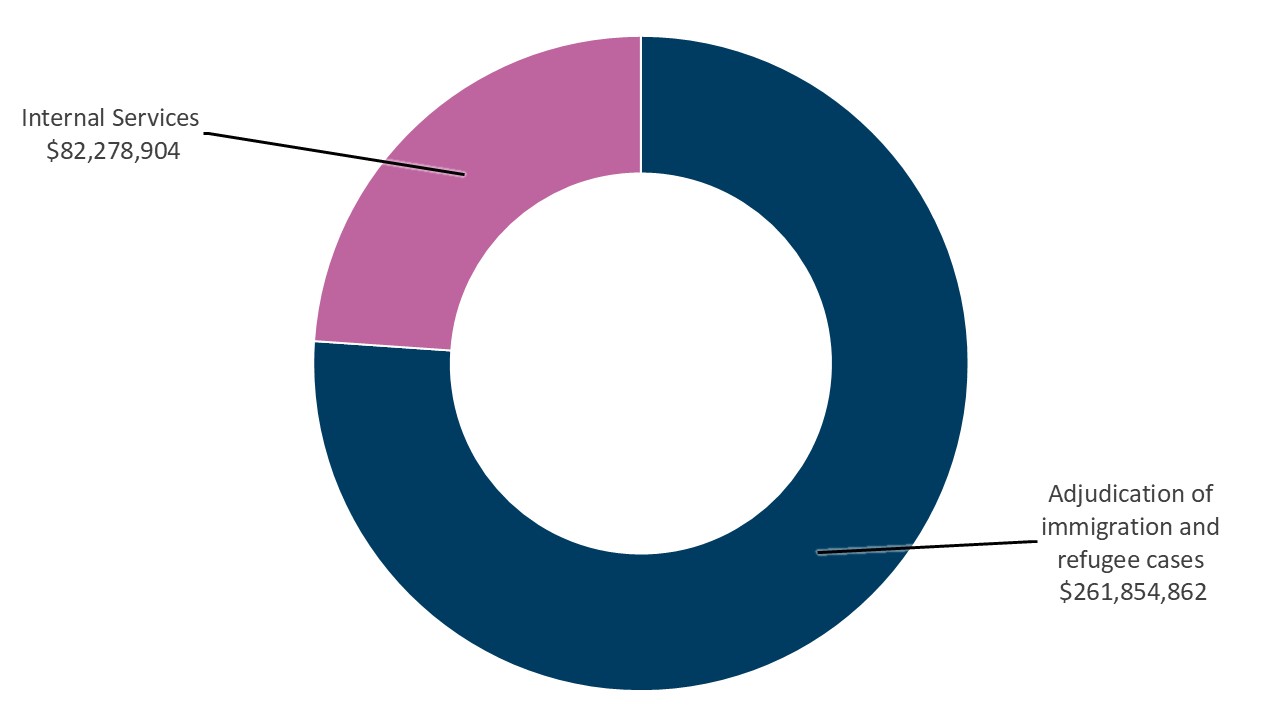
Text format - Graph 1 Planned spending by core responsibility in 2026 to 2027
| Core responsibility and internal services | 2026 to 2027 planned spending |
|---|
Adjudication of immigration and refugee cases | $261,854,862 |
Internal services | $82,278,904 |
Analysis of planned spending by core responsibility
The above pie chart shows that 76% of planned spending is allocated to the IRB's core responsibility and 24% to support internal services.
Budgetary performance summary
Table 5 Three-year spending summary for the core responsibility and internal services (dollars)
Table 5 presents the Board's spending over the past three years to carry out its core responsibility and for internal services. Amounts for the 2025 to 2026 fiscal year are forecasted based on spending to date.
| Core responsibility and internal services | 2023 to 2024 actual expenditures | 2024 to 2025 actual expenditures | 2025 to 2026 forecast spending |
|---|
Adjudication of immigration and refugee cases | $253,103,632 | $273,278,219 | $254,759,188 |
Subtotal(s) |
$253,103,632 |
$273,278,219 |
$254,759,188 |
Internal services | $88,152,882 | $79,596,812 | $79,972,096 |
Total (s) |
$341,256,514 |
$352,875,031 |
$334,731,283 |
Analysis of the past three years of spending
Spending in 2024 to 2025 reflects temporary funding and surge capacity measures used to address elevated caseloads. As these initiatives conclude, planned spending is expected to decline in 2025 to 2026.
The renewal of the IRB's temporary funding for two additional years, announced in Budget 2025, will allow the Board to maintain enhanced capacity through fiscal years 2026 to 2027 and 2027 to 2028. This extension supports service continuity and mitigates short‑term operational risks.
More financial information from previous years is available on the
Finances section of GC Infobase.
Table 6 Planned three-year spending on the core responsibility and internal services (dollars)
Table 6 presents the Board's planned spending over the next three years by core responsibility and for internal services.
| Core responsibility and internal services | 2026 to 2027 planned spending | 2027 to 2028 planned spending | 2028 to 2029 planned spending |
|---|
Adjudication of immigration and refugee cases | $261,854,862 | $264,318,523 | $242,773,017 |
Subtotal |
$261,854,862 |
$264,318,523 |
$242,773,017 |
Internal services | $82,278,904 | $80,732,741 | $75,410,729 |
Total |
$344,133,766 |
$345,051,264 |
$318,183,746 |
Analysis of the next three years of spending
Planned spending remains stable at $344.1 million in fiscal year 2026 to 2027, supported by ongoing authorities and temporary funding that sustains enhanced operational capacity. Spending is expected to remain relatively consistent in fiscal year 2027 to 2028, at $345.1 million, before declining to $318.2 million in fiscal year 2028 to 2029 due to sunsetting of time‑limited Budget 2025 measures. The reduction over this period reflects the planned withdrawal of temporary resources rather than decreased program demand. The IRB will continue to pursue efficiency and productivity improvements to mitigate the impact of declining authorities and to maintain decision‑making capacity in line with service standards.
More
detailed financial information on planned spending is available on the Finances section of GC Infobase.
Funding
This section provides an overview of the Board's voted and statutory funding for its core responsibility and for internal services. For further information on funding authorities, consult the
Government of Canada budgets and expenditures.
Graph 2: Approved funding (statutory and voted) over a six-year period
Graph 2 summarizes the Board's approved voted and statutory funding from fiscal year 2023 to 2024 to fiscal year 2028 to 2029.
.jpg)
Text format - Graph 2: Approved funding (statutory and voted) over a six-year period
| Fiscal year | Total | Voted | Statutory |
|---|
2023 to 2024 | $377,272,248 | $340,725,368 | $36,546,880 |
2024 to 2025 | $360,445,208 | $321,857,871 | $38,587,337 |
2025 to 2026 | $357,700,937 | $321,259,001 | $36,441,936 |
2026 to 2027 | $344,133,766 | $302,785,263 | $41,348,503 |
2027 to 2028 | $345,051,264 | $305,123,233 | $39,928,031 |
2028 to 2029 | $318,183,746 | $282,013,365 | $36,170,381 |
Analysis of statutory and voted funding over a six-year period
The graph above illustrates the IRB's approved funding over a six‑year period. Voted appropriations decrease gradually from fiscal year 2023 to 2024 to fiscal year 2026 to 2027 as temporary resources from Budget 2022 and Budget 2024 sunset. Funding stabilizes in fiscal years 2026 to 2027 and 2027 to 2028 following the approval of two-year temporary funding in Budget 2025 and is expected to decline in fiscal year 2028 to 2029 as those measures sunset.
Statutory authorities remain relatively stable throughout the period, ranging from $36.2 million to $41.3 million.
For further information on the IRB's departmental appropriations, consult the
2026-27 Main Estimates.
Future-oriented condensed statement of operations
The future-oriented condensed statement of operations provides an overview of the Board's operations for fiscal year 2025 to 2026 to fiscal year 2026 to 2027.
Table 7 Future-oriented condensed statement of operations for the year ended March 31, 2027 (dollars)
Table 7 summarizes the expenses and revenues which net to the cost of operations before government funding and transfers for fiscal year 2025 to 2026 to fiscal year 2026 to 2027. The forecast and planned amounts in this statement of operations were prepared on an accrual basis. The forecast and planned amounts presented in other sections of the Departmental Plan were prepared on an expenditure basis. Amounts may therefore differ.
| Financial information | 2025 to 2026 forecast results | 2026 to 2027 planned results | Difference (Planned results minus forecasted) |
|---|
Total expenses | $383,528,076 | $396,018,657 | $12,490,581 |
Total revenues | $0 | $0 | $0 |
Net cost of operations before government funding and transfers | $383,528,076 | $396,018,657 | $12,490,581 |
Analysis of forecasted and planned results
The net cost of operations before government funding and transfers forecasted results for fiscal year 2025 to 2026 is consistent with the planned results for fiscal year 2026 to 2027. The temporary funding extension for the IRB announced in Budget 2025 is reflected in 2026 to 2027 and serves to stabilize operations during this period in the corresponding forecasted and planned operating costs.
A more detailed
Future-Oriented Statement of Operations and associated Notes for 2026-27, including a reconciliation of the net cost of operations with the requested authorities, is available on the IRB's website.
Human resources
This section presents an overview of the Board's actual and planned human resources from fiscal year 2023 to 2024 to fiscal year 2028 to 2029.
Table 8: Actual human resources for the core responsibility and internal services
Table 8 shows a summary of human resources, in full-time equivalents, for the IRB's core responsibility and for its internal services for the previous three fiscal years. Human resources for the 2025 to 2026 fiscal year are forecasted based on year to date.
| Core responsibility and internal services | 2023 to 2024 Actual full-time equivalents | 2024 to 2025 Actual full-time equivalents | 2025 to 2026 Forecasted full-time equivalents |
|---|
Adjudication of immigration and refugee cases | 1,918 | 2,051 | 1,985 |
Subtotal |
1,918 |
2,051 |
1,985 |
Internal services | 477 | 522 | 474 |
Total |
2,395 |
2,573 |
2,459 |
Analysis of human resources over the last three years
The IRB's full‑time equivalents increased from 2,395 in fiscal year 2023 to 2024 to 2,573 in fiscal year 2024 to 2025, reflecting temporary funding and surge hiring to address high caseloads. For fiscal year 2025 to 2026, full‑time equivalents are forecasted to decline slightly to 2,459 as short‑term initiatives wind down and as the Board was preparing for a reduction due to sunsetting funding in 2026 to 2027. In fiscal year 2025 to 2026, the largest portion of the IRB's resources were aligned with its core responsibility while internal services resources decreased. This is consistent with the Board's efforts to streamline administrative functions.
Table 9: Human resources planning summary for the core responsibility and internal services
Table 9 shows information on human resources, in full-time equivalents, for the Board's core responsibility and for its internal services planned for the next three years.
| Core responsibility and internal services | 2026 to 2027 planned full-time equivalents | 2027 to 2028 planned full-time equivalents | 2028 to 2029 planned full-time equivalents |
|---|
Adjudication of immigration and refugee cases | 1,983 | 2,002 | 1,827 |
Subtotal |
1,983 |
2,002 |
1,827 |
Internal services | 492 | 483 | 459 |
Total |
2,475 |
2,485 |
2,286 |
Analysis of human resources for the next three years
Table 9 presents the Board's planned human resources, expressed in full‑time equivalents (FTEs), for its core responsibility and internal services over the next three fiscal years. Planned FTEs remain concentrated in the core responsibility, reflecting the staffing required to support adjudication activities. Internal services show a gradual decline over the planning period, consistent with efforts to streamline administrative functions. These figures incorporate the temporary two-year funding extension announced in Budget 2025, resulting in sustained capacity through fiscal year 2027 to 2028 before declining in fiscal year 2028 to 2029 as temporary authorities sunset.
Federal tax expenditures
The Board's Departmental Plan does not include information on tax expenditures.
The tax system can be used to achieve public policy objectives through the application of special measures such as low tax rates, exemptions, deductions, deferrals and credits. The Department of Finance Canada publishes cost estimates and projections for these measures each year in the
Report on Federal Tax Expenditures.
This report also provides detailed background information on tax expenditures, including descriptions, objectives, historical information and references to related federal spending programs as well as evaluations and GBA Plus of tax expenditures.
Corporate information
Organizational profile
Appropriate minister: The Honourable Lena Metlege Diab, ECNS, KC, PC, MP
Institutional head: Manon Brassard, Chairperson and Chief Executive Officer
Ministerial portfolio: Immigration, Refugees and Citizenship
Enabling instrument: Immigration and Refugee Protection Act
Year of incorporation/commencement: 1989
Organizational contact information
Mailing address
Immigration and Refugee Board of Canada
Minto Place, Canada Building
344 Slater Street, 12th floor
Ottawa (Ontario) K1A 0K1
Canada
For more contact information, visit
Contact Us.
Follow us on X (Twitter), Facebook, or
LinkedIn.
Definitions
List of terms
- appropriation (crédit)
- Any authority of Parliament to pay money out of the Consolidated Revenue Fund.
- budgetary expenditures (dépenses budgétaires)
- Operating and capital expenditures; transfer payments to other levels of government, departments or individuals; and payments to Crown corporations.
- core responsibility (responsabilité essentielle)
- An enduring function or role performed by a department. The intentions of the department with respect to a core responsibility are reflected in one or more related departmental results that the department seeks to contribute to or influence.
- Departmental Plan (plan ministériel)
- A report on the plans and expected performance of an appropriated department over a three-year period. Departmental Plans are usually tabled in Parliament each spring.
- departmental result (résultat ministériel)
- A consequence or outcome that a department seeks to achieve. A departmental result is often outside departments' immediate control, but it should be influenced by program-level outcomes.
- departmental result indicator (indicateur de résultat ministériel)
- A quantitative measure of progress on a departmental result.
- departmental results framework (cadre ministériel des résultats)
- A framework that connects the department's core responsibilities to its departmental results and departmental result indicators.
- Departmental Results Report (rapport sur les résultats ministériels)
- A report on a department's actual accomplishments against the plans, priorities and expected results set out in the corresponding Departmental Plan.
- full-time equivalent (équivalent temps plein)
- A measure of the extent to which an employee represents a full person-year charge against a departmental budget. For a particular position, the full-time equivalent figure is the ratio of number of hours the person actually works divided by the standard number of hours set out in the person's collective agreement.
- gender-based analysis plus (GBA Plus) (analyse comparative entre les sexes plus [ACS Plus])
- Is an analytical tool used to support the development of responsive and inclusive policies, programs, and other initiatives. GBA Plus is a process for understanding who is impacted by the issue or opportunity being addressed by the initiative; identifying how the initiative could be tailored to meet diverse needs of the people most impacted; and anticipating and mitigating any barriers to accessing or benefitting from the initiative. GBA Plus is an intersectional analysis that goes beyond biological (sex) and socio-cultural (gender) differences to consider other factors, such as age, disability, education, ethnicity, economic status, geography (including rurality), language, race, religion, and sexual orientation. Using GBA Plus involves taking a gender- and diversity-sensitive approach to our work. Considering all intersecting identity factors as part of GBA Plus, not only sex and gender, is a Government of Canada commitment.
- government priorities (priorités gouvernementales)
- For the purpose of the 2026 to 2027 Departmental Plan, government priorities are the high-level themes outlining the government's agenda in the
2025 Speech from the Throne.
- horizontal initiative (initiative horizontale)
- An initiative where two or more federal departments are given funding to pursue a shared outcome, often linked to a government priority.
- Indigenous business (entreprise autochtones)
- Requirements for verifying Indigenous businesses for the purposes of the departmental result report are available through the Indigenous Services Canada
Mandatory minimum 5% Indigenous procurement target website.
- non‑budgetary expenditures (dépenses non budgétaires)
- Non-budgetary authorities that comprise assets and liabilities transactions for loans, investments and advances, or specified purpose accounts, that have been established under specific statutes or under non-statutory authorities in the Estimates and elsewhere. Non-budgetary transactions are those expenditures and receipts related to the government's financial claims on, and obligations to, outside parties. These consist of transactions in loans, investments and advances; in cash and accounts receivable; in public money received or collected for specified purposes; and in all other assets and liabilities. Other assets and liabilities, not specifically defined in G to P authority codes are to be recorded to an R authority code, which is the residual authority code for all other assets and liabilities.
- performance (rendement)
- What a department did with its resources to achieve its results, how well those results compare to what the department intended to achieve, and how well lessons learned have been identified.
- performance indicator (indicateur de rendement)
- A qualitative or quantitative means of measuring an output or outcome, with the intention of gauging the performance of a department, program, policy or initiative respecting expected results.
- plan (plan)
- The articulation of strategic choices, which provides information on how a department intends to achieve its priorities and associated results. Generally, a plan will explain the logic behind the strategies chosen and tend to focus on actions that lead to the expected result.
- planned spending (dépenses prévues)
- For Departmental Plans and Departmental Results Reports, planned spending refers to those amounts presented in Main Estimates. A department is expected to be aware of the authorities that it has sought and received. The determination of planned spending is a departmental responsibility, and departments must be able to defend the expenditure and accrual numbers presented in their Departmental Plans and Departmental Results Reports.
- program (programme)
- Individual or groups of services, activities or combinations thereof that are managed together within the department and focus on a specific set of outputs, outcomes or service levels.
- program inventory (répertoire des programmes)
- Identifies all the department's programs and describes how resources are organized to contribute to the department's core responsibilities and results.
- result (résultat)
- A consequence attributed, in part, to a department, policy, program or initiative. Results are not within the control of a single department, policy, program or initiative; instead they are within the area of the department's influence.
- statutory expenditures (dépenses législatives)
- Expenditures that Parliament has approved through legislation other than appropriation acts. The legislation sets out the purpose of the expenditures and the terms and conditions under which they may be made.
- target (cible)
- A measurable performance or success level that a department, program or initiative plans to achieve within a specified time period. Targets can be either quantitative or qualitative.
- voted expenditures (dépenses votées)
- Expenditures that Parliament approves annually through an appropriation act. The vote wording becomes the governing conditions under which these expenditures may be made.